Bond for Deed Myth #3: Buyers Are More Likely to Default
One of the most persistent myths surrounding Bond for Deed financing is the idea that buyers who use this method are more likely to default on their payments.
One of the most persistent myths surrounding Bond for Deed financing is the idea that buyers who use this method are more likely to default on their payments. This misconception often stems from another myth we’ve already addressed—that Bond for Deed is only used by buyers with poor credit.
The default risk associated with Bond for Deed contracts is no greater than that of traditional mortgage loans, especially when the transaction is structured properly, and the buyer has made a reasonable down payment.
Let us take a closer look at why this myth persists—and why it does not hold up under scrutiny.
💳 The Credit Misconception
Many people assume that buyers who choose Bond for Deed must be financially unstable or unable to qualify for a conventional mortgage due to poor credit. While Bond for Deed can be a helpful tool for buyers with temporary credit challenges, it is also used by:
- Investors who prefer flexible financing
- First-time buyers with limited credit history
- Buyers recovering from life events like divorce or medical expenses
- Buyers who simply want to avoid the red tape of traditional lending
In other words, Bond for Deed buyers are often financially capable, and their choice to use this method is strategic—not desperate.
📊 What the Data Shows
At Escrow Services, Inc., we have been servicing Bond for Deed contracts for over 35 years. During that time, we have seen a consistent trend:
Buyers who make a reasonable down payment are highly motivated to stay current on their payments.
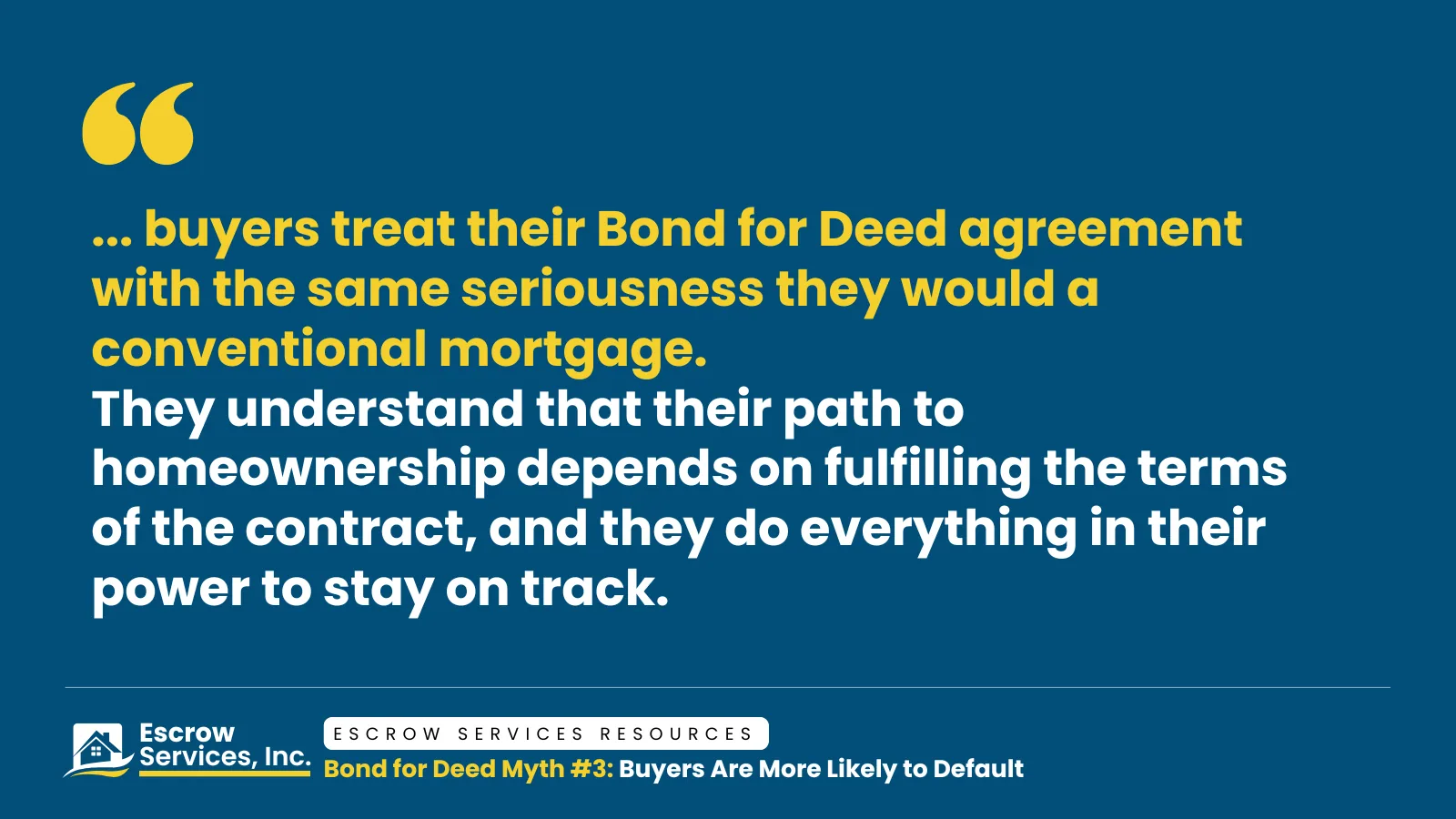
These buyers treat their Bond for Deed agreement with the same seriousness they would a conventional mortgage. They understand that their path to homeownership depends on fulfilling the terms of the contract, and they do everything in their power to stay on track.
In fact, our experience shows that default rates among Bond for Deed buyers with solid down payments are comparable to those in traditional mortgage portfolios.
💡 Why This Myth Persists
So why does the myth of high default rates continue to circulate?
Here are a few reasons:
- Lack of familiarity: Many agents and lenders simply have not worked with Bond for Deed transactions and rely on assumptions.
- Association with credit issues: Because Bond for Deed is sometimes used by buyers with non-traditional credit profiles, it is unfairly labeled as “risky.”
- Misunderstanding buyer motivation: Buyers who choose Bond for Deed often have strong financial discipline—they just need a different path to ownership.
✅ The Role of Down Payments
One of the most crucial factors in reducing default risk is the size of the buyer’s down payment. A substantial down payment signals commitment and financial stability. It also gives the buyer a personal stake in the property from day one.
When buyers have skin in the game, they are far more likely to make prompt payments and follow through on the contract.
🏗️ Structuring for Success
Another key to minimizing default risk is proper structuring of the Bond for Deed agreement. This includes:
- Clear payment terms
- Realistic amortization schedules
- Transparent communication between buyer and seller
- Professional servicing by a licensed escrow agent
At Escrow Services, we help ensure that every Bond for Deed contract is structured to protect both parties and promote long-term success.
📣 Final Thoughts
Bond for Deed is a powerful tool for expanding access to homeownership and facilitating flexible real estate transactions. But like any financing method, its success depends on how it is used.
When buyers are financially capable and contracts are properly structured, Bond for Deed is no more prone to default than a conventional mortgage.
Do not let myths and misunderstandings keep you—or your clients—from exploring this valuable choice.
📞 Contact Escrow Services, Inc.
If you have questions about how Bond for Deed works or want help structuring a secure transaction, we are here to help.
Phone: (985) 626-3727
Email: service@escrowserviceinc.com
Website: escroserv.com