Bond for Deed Fact #1: A Bond for Deed Functions Much Like a Mortgage Loan
A bond for deed operates in many ways like a traditional mortgage loan.
A bond for deed operates in many ways like a traditional mortgage loan.
At the outset, the parties agree on a purchase price. The buyer makes a down payment, and the remaining balance is financed over time, just as it would be with a mortgage.
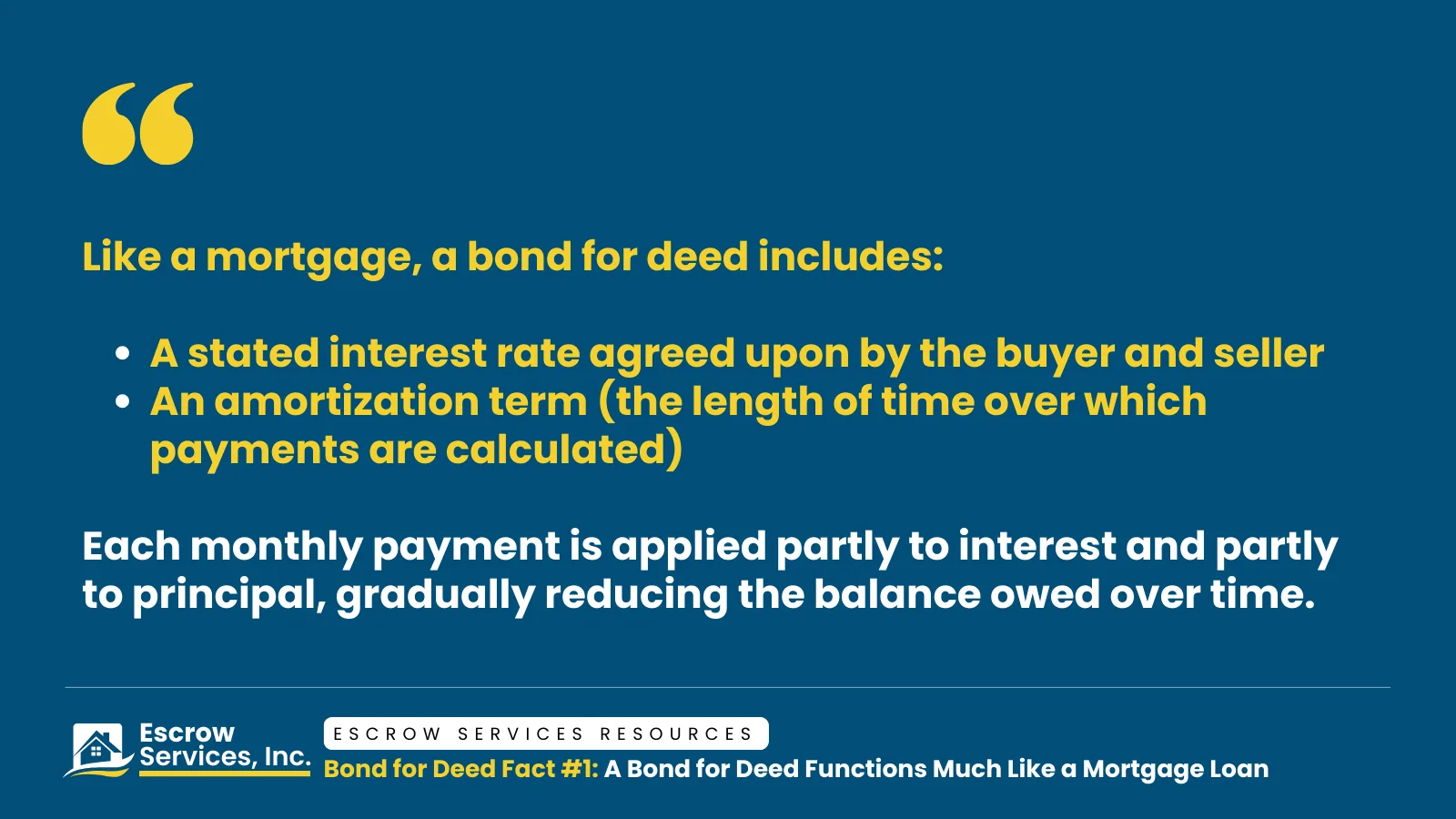
Like a mortgage, a bond for deed includes:
- A stated interest rate agreed upon by the buyer and seller
- An amortization term (the length of time over which payments are calculated)
Each monthly payment is applied partly to interest and partly to principal, gradually reducing the balance owed over time.
Escrows for Taxes and Insurance (Optional)
If both parties agree, a bond for deed payment may also include:
- Property taxes
- Insurance premiums
These amounts can be collected as an escrow payment and added to the principal-and-interest payment to create a single, total monthly payment—just as many mortgage lenders do. This is optional and entirely based on the agreement of the parties.
Amortization Terms
Most residential bond for deeds are amortized over a 30-year term, which closely mirrors conventional mortgage financing. However, the amortization period is flexible and can be:
- Shorter (commonly 15–20 years in commercial transactions), or
- Longer (in some investor transactions, 30, 40, or even 50 years, though this is less common)
All terms are fully negotiable between buyer and seller.
Balloon Payments Are Common
One key difference from a traditional mortgage is that bond for deeds typically include a balloon period.
While the payments may be calculated on a long amortization schedule (such as 30 years), the agreement usually requires the buyer to pay off the remaining balance early, often within:
- 3 to 5 years
The expectation is that, by the balloon date, the buyer will:
- Refinance the property, and
- Pay off the bond for deed in full, at which point title transfers to the buyer
Because of this structure, most bond for deeds do not run for the full amortization period—the longer term simply keeps payments affordable during the interim period.
Most importantly, just like a mortgage loan, the Bond for Deed allows the buyer to build equity in the property by paying down on principal each month. Also, although the title stays in the seller’s name until the Bond for Deed paid in full, the increase in market value of the property over time belongs to the buyer.